Showing posts with label Devotions. Show all posts

Thursday, October 23, 2008

A Great Prayer in Honor of St. Paul


Here's a great prayer that my parish is using in connection with our special study on the Pauline Epistles for the Year of St. Paul. The prayer was composed initially by the Diocese of Harrisburg, PA, but we liked it so much that we adopted it for use here at St. John, Westminster. It's a really great prayer that touches on a lot of the major themes Paul writes about in his letters. I hope you like it!

Prayer for the Year of St. Paul

God our Father, source of mercy and truth,
through the preaching of St. Paul the Apostle,

You teach us and deepen our faith.

Grant that we may follow St. Paul's example
and grow in holiness.
Strengthen us to continually turn
our hearts and minds to You.

Enliven us to live by the Spirit
in faith, hope, and charity.
Inspire us to hand on to others
what we have received from You.

Fortify us to pour out ourselves
and serve You with humility and compassion.
Move us to unite ourselves
to the sufferings of Christ, that we may
die with Him in order to rise with Him.

Help us to trust that nothing
can separate us from Your love.

Direct us to seek only the things of heaven
so that after running the race
and fighting the good fight,
we might share the crown of glory
promised to those who love You.

We ask this through Christ our Lord. Amen
Saint Paul the Apostle, pray for us.

Tuesday, August 5, 2008

A Little Diversion - Thoughts from Rome on Proper "Ars Celebrandi"


While letting issues of greater depth and importance stew in my mind, I'll give you all a little diversion to occupy you in the meanwhile. Not to say that what I have to say now isn't something worthy of focused meditation and serious consideration. What I have here is a little article, published recently in the Vatican newspaper, L'Osservatore Romano, The Roman Observer, and translated by the NLM (I should start paying royalties for all I borrow from them). Thanks again to Gregor Kollmorgen.

As you read this article, even though you may be neither a priest nor seminarian, reflect yourself on your own experience of Sunday Mass. Think about your most "satisfying" experience of Mass, and ask yourself why it was such. What about moved you to greater Faith and Love of God and His Son Jesus, but most of all, what about it moved you to a greater appreciation and devotion of His Real Presence in the Eucharist. Compare that with the article, and maybe post a comment telling me what you think. I hope this article really inspires and clarifies for you all the purpose of Liturgy, and why the manner in which it is celebrated is of utmost importance. I plan to address this question in greater detail as soon as things quiet down in my life, as it is for me a question of great importance.

That said, I hope you find this article enlightening. All emphasis belongs to Gregor Kollmorgen and The New Liturgical Movement. Enjoy:


The Art of Celebrating the Liturgical Service

A reflection in the light of the teaching of the Church

By Nicola Bux

In order to celebrate the liturgical service with art, the priest must not resort to mundane artifices but focus on the truth of the Eucharist. The General Instrucion of the Roman Missal states: "A priest also ... when he celebrates the Eucharist, ... must serve God and the people with dignity and humility, and by his bearing and by the way he says the divine words he must convey to the faithful the living presence of Christ." The priest does not make up anything, but with his service he must render as well as possible to the eyes and ears, but also to the touch, taste and scent of the faithful, the sacrifice and thanksgiving of Christ and of the Church, whose tremendous mystery may be approached by those who have cleansed themselves from sins. How can we draw near to Him if we do not have the feeling of John the precursor: "He must increase, but I must decrease." (John 3, 30)? If we want the Lord to walk with us, we have to recover this awareness, otherwise we deprive our act of devotion of efficacy: the effect depends on our faith and our love.

The Priest Is Not Master of the Mysteries

The priest is minister, not master, administrator of the mysteries: he serves them, and does not use them to project his own theological or political ideas and his own image, to the point that the faithful become focused on him rather than look to Christ Who is signified by the altar and present on the altar, and high upon the cross. As the Holy Father recently warned, the culture of the image in the worldly sense marks and conditions also the faithful and the shepherds. The Italian television, as a comment to this discourse, showed a concelebration in which some priests were talking on the mobile phone. From the manner of celebrating Mass many things can be deduced: the chair of the celebrant in many places has decentralised cross and tabernacle, occupying the centre of the church, sometimes overtowering in importance the altar, ending up by resembling an episcopal cathedra, which in Eastern churches [Don Bux is also lecturer for comparative liturgy at the Ecumenical Institute of Bari - NLM] is outside of the iconostasis, to one side clearly visible. It was thus also with us before the liturgical reform.

The ars celebrandi consists in serving with love and fear the Lord: for this is expressed with kisses of the mensa and the liturgical books, bows and genuflections, signs of the cross and incensations of people and objects, gestures of offering and supplication, and the showing of the Evangeliary and of the Holy Eucharist.

Now, such a service and style of the priest celebrant or, as people love to say, the presider of the assembly - a term that leads to misunderstand the liturgy as a democratic act - can be seen from his preparing himself at vesting in the sacristy in silence and recollection for the great action that is preparing to do; from his going to the altar, which must be humble, not ostentatious, without indulging in looking to the right and left, almost as if to seek applause. Indeed, the first act is the bow or genuflection before the cross and the tabernacle, in short before the divine presence, followed by the reverent kiss of the altar and possibly by the incensation. The second act is the sign of the cross and the sober greeting of the faithful. The third one is the penitential act, to be made profoundly and with eyes lowered, while the faithful might kneel, as in the old rite - why not? - imitating the publican who pleased the Lord. The readings will be proclaimed as a word not of our own, thus with a clear and humble tone. Like the priest bows while asking for his lips and heart to be purified in order to worthily proclaim the Gospel, why could not the lectors do the same, if not visibly as in the Ambrosian rite, at least in their hearts? The voice will not be raised like in the streets, and a clear tone will be maintained for the homily, but a quiet and supplicatory one for the prayers, solemn if in song. The priest will compose himself bowed down to celebrate the anaphora still "with humble spirit and contrite heart."

The Eucharistic Wonder

He will touch the holy gifts with wonder and astonishment - the Eucharistic amazement about which John Paul II often talked - and with adoration, and the sacred vessels he will cleanse calmly and carefully, as so many fathers and saints call for. He will bow over the bread and the chalice in saying the consecrating words of Christ and while invoking the Holy Spirit at the supplication or epiclesis. He will elevate them separately fixing his gaze on them in adoration and then lowering it in meditation. He will genuflect twice in solemn adoration. He will continue with recollection and a tone of prayer the anaphora until the doxology, elevating the holy Gifts offering them to the Father. He will recite the Our Father with his hands raised and without holding others by the hand, because that is proper to the rite of peace. The priest will not leave the Sacrament on the altar to offer the sign of peace outside the sanctuary. Instead he will break the host solemnly and visibly, and then genuflect before the Eucharist and pray silently asking again to be freed from every unworthyness in order not to eat and drink his own condemnation and to be preserved for eternal life by the holy Body and precious Blood of Christ. Then he will present the Host to the faithful for communion, supplicating Domine non sum dignus, and bowed he will himself communicate first. Thus he will serve as an example to the faithful.

After communion there will be thanksgiving in silence, which better than sitting can be done standing as a sign of respect or kneeling, if possible, as John Paul II did until the end, with head bowed and hands joined; in order to ask that the gift received be for us a remedy for eternal life, as is being said while the sacred vessels are being purified. Many faithful are doing this and they are an example for us. The priest, after the final greeting and blessing, going the altar to kiss it, again lifts his eyes to the cross and bows, or genuflects to the tabernacle. Then he returns to the sacristy, recollected, without dissipating with glances and words with the grace of the mystery celebrated.

Thus the faithful will be helped to understand the holy signs of the liturgy, which is a serious matter, and in which everything has a meaning for the encounter with the mystery present.

Paul VI, in the instruction Eucharisticum Mysterium, recalls a central truth propounded by St. Thomas: "This Sacrifice, then, as the passion of Christ itself, even though it is offered for everyone, 'has no effect if not in those who unite thmesleves to the passion of Christ through faith and charity ... To them, still, it helps more or less according to the measure of their devotion'". Faith is a condition of participation in the sacrifice of Christ with all myself. In what consists the action of the faithful, different from the priest who consecrates? They, remembering, give thanks, offer and, conveniently disposed, communicate sacramentally. The most intense expression is in the response to the invitation of the priest shortly before the anaphora: "May the Lord accept the sacrifice at your hands for the praise and glory of his name, for our good and the good of all his holy Church."

Without faith and devotion of the priest there is no ars celebrandi and the participation of the faithful is not favoured, above all the perception of the mystery. Because to the Lord "are known ... [our] faith and devotion" (Roman Canon) which express themselves in the sacred gestures, bows, genuflections, hands joined, remaining kneeling. The lack of devotion in the liturgy impels many of the faithful to abandon it and dedicate themselves to secondary forms of piety, widening the gap between the one and the other.

Since the sacred liturgy is an act of Christ and the Church, not the result of our ability, it does not foresee a success which to applaud. The liturgy is not ours but his.

The Tradition of the Church

The Congregation for Divine Worship and the Discipline of the Sacraments in the instruction Redemptionis Sacramentum reminds the priest of his promise of at ordination, renewed from year to year during the Chrism Mass, to celebrate "devoutly and faithfully the mysteries of Christ for the praise of God and the sanctification of the Christian people, according to the tradition of the Church"(No. 31).

He is called upon to act in the person of Christ, he must therefore imitate Him in the supreme act of prayer and offering, and he must not deform the liturgy into a representation of his ideas, change and add anything whatsoever arbitrarily: "The Mystery of the Eucharist 'is too great for anyone to permit himself to treat it according to his own whim, so that its sacredness and its universal ordering would be obscured'."(Ibid., 11). The Mass is not the property of the priest or the community. The instruction abundantly expounds how Mass should be rightly celebrated, that is the ars celebrandi: seminarians first must learn it carefully so that they can implement it as priests.

Benedict XVI, in Sacramentum Caritatis devotes attention to the ars celebrandi (No. 38-42), understood as the art of celebrating properly, and makes of it the condition for active participation of the faithful: "The ars celebrandi is the fruit of faithful adherence to the liturgical norms in all their richness; indeed, for two thousand years this way of celebrating has sustained the faith life of all believers"(38). In the note 116 Propositio No 25 specifies that "An authentic liturgical action expresses the sacredness of the eucharistic mystery. This should be evident from the words and actions of the priest who celebrates, as he intercedes to God the Father both with the faithful and on their behalf." Then the exhortation recalls that "The ars celebrandi must foster a sense of the sacred and the use of outward signs which help to cultivate this sense, such as, for example, the harmony of the rite, the liturgical vestments, the furnishings and the sacred place" (40). Speaking of sacred art, it recalls the unity among altar, crucifix, tabernacle, ambo and chair (41): attention to the sequence which reveals the order of importance. Together with the image, the song must also serve to orient the understanding and the encounter with the mystery.

The bishop and the priest are called to express all this in the liturgy which is sacred and divine, in a manner that truly manifests the creed of the Church.

Monday, June 23, 2008

An Unexpected Blessing


Hey all. I've been pretty busy recently, so I haven't been able to write posts on some of the more burning questions and issue that I've been wrestling with lately. To give you a preview, I'll say that I've been thinking more about Dawkins' book, the God Delusion and am eager to really break it open and see what he has to say. I've also been digging into the question of the Protestant views of salvation and justification, and how they compare to the Catholic views. Pretty cool stuff, and I'm really eager to write about them and share my thoughts with you on them. But, in the meantime, I'll just leave you this...

I was eating lunch today with my pastoral supervision, Fr. Steve Hook, and a friend and fellow seminarian. Since it was during the day, Fr. Steve and I walked into the diner with our clerics on, and the area we live in is not one that has been historically very welcoming to the Catholic Church. But there we are, eating our diner food (and was it good diner food!) when an older gentlemen approaches our table and sets some small, pocket size pieces of paper at the edge of the table, saying something along the lines of "just in case you don't have this at your parishes," and walked away. Not too sure of what they were, and even what religion the fellow was, we hesitated. But finally I picked up the materials and was instantly warmed and surprised to find this written on them

Our Lady of Guadalupe, Patroness of the Unborn

To help stop the anti-life push in the U.S., Archbishop Fulton J. Sheen encouraged the spiritual adoption of an unborn child. This is done by praying that one particular but unknown child's life be spared abortion and be allowed to continue to and after birth.

To accomplish this, it was recommended an individual say the following daily prayer for a period of one year:

"Jesus, Mary and Joseph, I love you very much. I beg you to spare the life of the unborn baby that I have spiritually adopted who is in danger of abortion."

During your earthly life this spiritually adopted child of yours will be known only to God, but in the world to come and throughout eternity both you and the child will find happiness in each other's company.
Indeed, a very heart warming thing to find. It's wonderful to be able to see the little ways in which God reveals Himself throughout the day. Truly, every second of our day He blesses us somehow, in some way. We must only open our hearts so that He can give us the faith to see it. May He bless you today and everyday and give you the grace to see His presence in your lives. Then, He will be able to fill you with "the peace which surpasses all understanding" (Phil. 4:7a). I hope to be able to write more extensively soon. Until then, in the words of the Ven. Fulton Sheen, "Good night, and God love you!"

Sunday, April 13, 2008

Prayer for Conversion of Sinners and the Perfection of the Faithful


I was just reading one of my favorite blogs, Mount Carmel Catholic Blogger, and I ran across a beautiful prayer that I just had to post on my blog. It's a prayer for the conversion of souls in the state of mortal sin, and also for the grace of those who are in the state of grace to advance to saintly perfection by the frequent reception of Holy Communion.

I love this prayer because I can't say enough about the absolute importance and centrality of the Holy Eucharist. The Second Vatican Council said of this sacrament in the Constitution on the Sacred Liturgy, Sacrosanctum Concilium, that it is "the source and summit of the Christian Life." And in Lumen Gentium it says:
"The other sacraments, and indeed all ecclesiastical ministries and works of the apostolate, are bound up with the Eucharist and are oriented toward it. For in the blessed Eucharist is contained the whole spiritual good of the Church, namely Christ himself, our Pasch."
There is nothing more vital and necessary to the life of the soul than the Bread of Life, Jesus, our source of every nourishment. Everything we do, no matter how mundane, worldly, or ordinary our tasks maybe, all of it finds it's light and sustenance in the Most Holy Sacrament of the Altar. Pray this prayer often. There is nothing better you can do for the good of souls than wish that they commune ever so intimately with Savior. And let it inspire you to make frequent and devout Holy Communions.

O Sweetest Jesus, Who camest into this world to give to all the life of Thy grace, and Who, to preserve and sustain it, didst will to be the remedy of our daily infirmities, and our daily food; humbly we pray Thee, by Thy Heart, all on fire for love of us, to pour out Thy Holy Spirit upon all, so that those who are unhappily in mortal sin may be converted to Thee, and recover the life of grace which they have lost; and those who by Thy gift still live this Divine life, may every day, when they are able, approach devoutly to Thy holy table, where, in daily Holy Communion, receiving every day the antidote to their daily venial sins, and nourishing the life of grace in their hearts, and purifying more and more their souls, they may come at last to the enjoyment with Thee of eternal beatitude. Amen.

Heart of Jesus, burning with love for us, inflame our hearts with love of Thee!


Sunday, March 30, 2008

Mary, Queen and Mother.

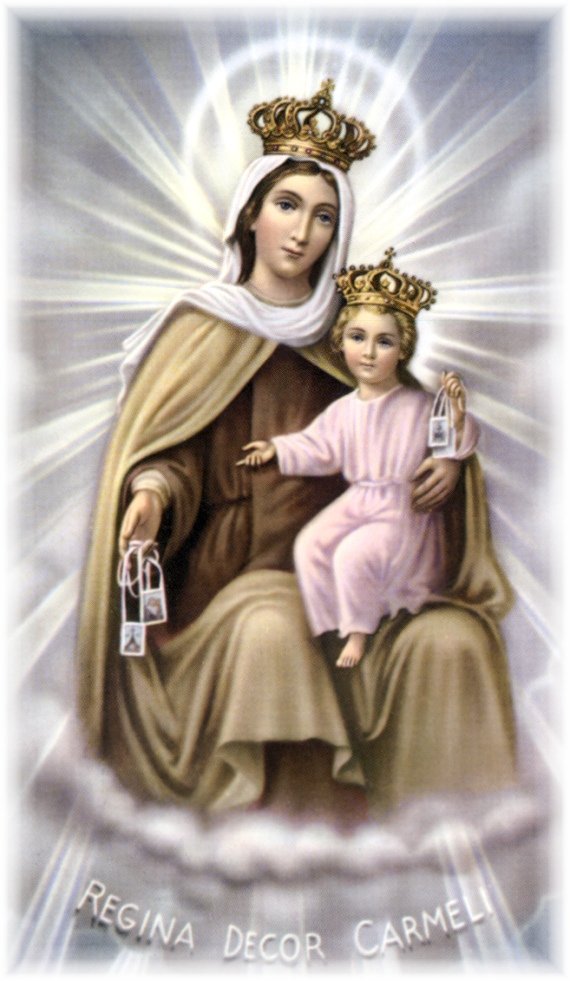
With all my thoughts lately on holiness, I have been naturally led to reflect on Mary's role in the lives of every follower of Jesus. Tomorrow is the Solemnity of the Annunciation of the Lord, the feast during which we celebrate Mary's yes to God's call for her to be the Mother of His Son, a yes so radical that God took on flesh in her womb. In part to celebrate this feast, I participated in an ancient Marian devotion just this evening: the blessing and vesting with the Brown Scapular of Our Lady of Mount Carmel.

What is a scapular, you ask? A scapular was originally a part of a monk's habit. It was a rectangular cloth, about the width of the shoulders, that hung over the shoulders all the way down the length of the habit, both front and back. The word "scapular" comes from the Latin scapula, which means shoulder, and it symbolizes the yoke of Christ which all Christians are called to bear. Now adays, they have been altered popular use, and not just those who have taken vows with a religious order, although by wearing them, you are considered affiliated in some way with that order. These "lay scapulars" tend to be much smaller, maybe a few square inches in size, and hang over the shoulders by a chain or a ribbon attaching the two sides (see picture below). The Brown Scapular, specifically, is associated with the Carmelite religious order, an order devoted to mysticism and contemplative prayer. The brown scapular was given to the superior general of the order, St. Simon Stock, but Our Lady in a vision in his room in Cambridge, England. That was around 1251. With this gift came an awesome promise: "Whosever shall die while wearing this scapular shall not suffer the eternal fire." Basically this promise means that anyone who lives a good Christian life and dies in the friendship of God (i.e. in the state of grace), while wearing this gift of Mary's, will enjoy forever, in unimaginable bliss, the face of God.

But what's the wearing of little brown cloth have to do with my salvation? Well, in the Catholic mindset, to quote a theology teacher of mine from my College Seminary days: "matter matters." I mean that Catholicism is a religion that acknowledges the importance of the physical in God's plan. After all, He did think it a good idea to take human body so that he could really commiserate with our poor, broken nature. By taking on flesh, Jesus showed us that our bodies are good, and that the material world is His creation, and a source of grace, signifying His presence in our world. That's the whole point of the Incarnation, to catch up into the divine our lowly humanity! And that's why we celebrate the Annunciation, thanking Mary for making it all possible by her "yes," her fiat. By wearing this brown scapular, we are always silently remembering her devotion and love for God and her children. We are all her children, for we are all one body in her Son. By wearing this scapular, we are silently lifting up a perpetual prayer to her, pleading for her protection, and asking her to show us Jesus, just like she did for the shepherds on Christmas day. Mary is our advocate, our defender, our great example, God's promise of our future glory. And by wearing this scapular-by devoting ourselves to Mary without reserve-God showers us with His favors. And what Son would not be pleased in seeing His Mother so honored.

So don't be afraid to devote yourself to our Lady. She gave Christ to the world by her humble obedience, and she can show us how to do the same. She can give birth again and again to Jesus in our own hearts, and the hearts of others. Peace be with you, and Mary keep you!